
What Are the Key Pros and Cons of Choosing a Stripe Merchant Account for a New or Growing Online Business?

Choosing the right payment processor can have a major impact on an online business. A new company needs a payment solution that is easy to set up, while a growing business also needs reliable processing, manageable costs, fraud protection, and enough flexibility to handle increasing transaction volumes.
A stripe merchant account can be a practical option for many online businesses. It offers payment processing tools, online checkout capabilities, recurring billing, and integrations for websites and applications. However, it also has limitations that business owners should understand before making a decision.
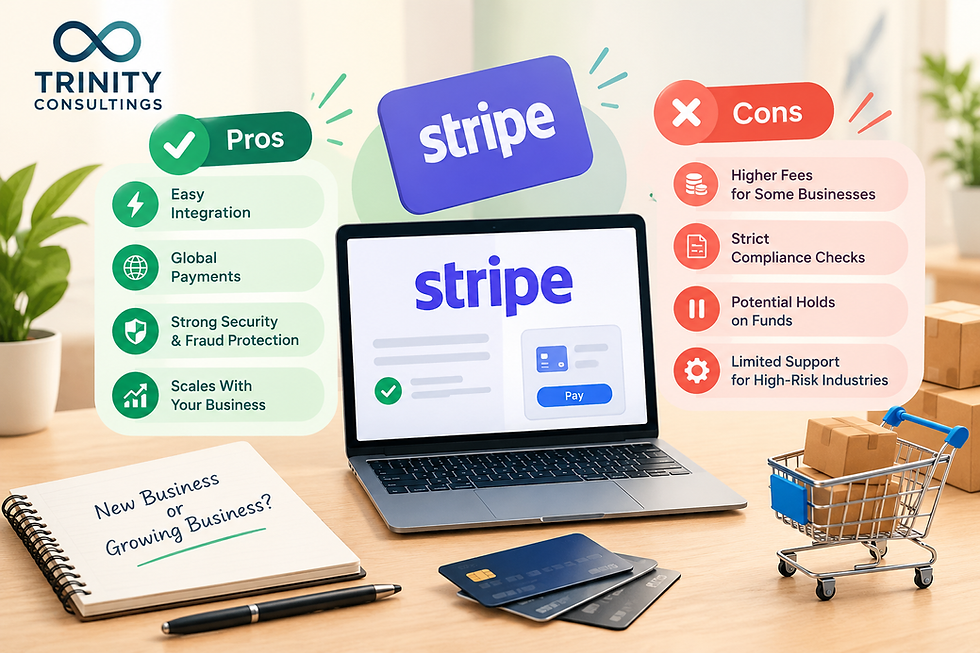
What Are the Pros of a Stripe Merchant Account?
Stripe can be appealing to online businesses for several reasons.
Easy Payment Integration
One of Stripe's main advantages is its integration with websites, applications, ecommerce platforms, and other digital services. Businesses can use Stripe's payment tools without having to build an entire payment infrastructure independently.
Supports Recurring Payments
Businesses offering subscriptions, memberships, or ongoing services can benefit from recurring payment capabilities. This can make it easier to manage regular customer billing.
Scalable for Growing Businesses
As a business grows, its payment requirements may become more complicated. Stripe provides payment infrastructure that can support different online payment needs, although available features vary depending on location and business circumstances.
Multiple Payment Methods
Stripe supports various payment methods depending on the country and business setup. This can give online businesses more flexibility when serving customers with different payment preferences.
Payment Management Tools
Businesses can use Stripe's platform to manage transactions, refunds, disputes, and other payment-related activities. Having these functions in one system can simplify payment administration.
What Are the Cons of a Stripe Merchant Account?
Stripe also has limitations that should not be overlooked. The biggest concern for some businesses is how payment risk is assessed and managed.
Account Reviews and Restrictions
Stripe evaluates businesses and payment activity for potential risk. Changes in transaction patterns, disputes, unusual activity, or other risk factors can result in additional review or requests for information.
For a growing business, this makes it important to maintain accurate business information and understand how dependent the company is on one payment processor.
Not Every Business Is Eligible
Stripe has prohibited and restricted business categories. Some businesses may require additional review, while certain activities may not be supported.
Before applying, businesses should check whether their products, services, and business model meet the processor's current requirements.
Higher-Risk Businesses May Need Specialized Processing
Businesses with higher exposure to chargebacks, fraud, regulatory concerns, or financial losses may need a high risk merchant account rather than standard payment processing.
High-risk processing can come with considerations such as:
Higher processing fees
Rolling or other reserve requirements
Additional underwriting
Stricter transaction monitoring
Different settlement conditions
The exact terms depend on the provider and the business's risk profile.
Rapid Growth Can Create Additional Challenges
A sudden increase in transaction volume can change how a business is assessed from a risk perspective. For example, a company that experiences a significant increase in sales should maintain documentation relating to its products, customers, fulfillment process, and transaction history.
When Is Stripe a Good Fit?
Stripe may make sense for businesses with straightforward products or services, predictable payment activity, and online payment requirements that fit its supported services.
It can be worth considering if your business:
Sells products or services online.
Needs website or application payment integration.
Offers subscriptions or recurring services.
Has relatively predictable transaction activity.
Needs access to multiple online payment methods.
Expects its payment requirements to grow over time.
On the other hand, businesses with higher chargeback exposure, unusual transaction patterns, or restricted business models should compare other options before relying on Stripe.
What Should You Consider Before Choosing Stripe?
Don't compare payment processors based only on transaction fees. Look at the complete payment-processing arrangement.
Before choosing Stripe merchant services, consider:
Whether your industry and business model are supported.
Your expected monthly processing volume.
Your average transaction size.
Potential chargeback and refund rates.
How quickly you need access to your funds.
Whether your transaction volume could increase rapidly.
Whether you need specialized high-risk processing.
What payment methods your customers expect to use.
These factors can help you determine whether Stripe is suitable for your current needs and future growth.
Final Takeaway
A Stripe merchant account can be a convenient option for many new and growing online businesses because it provides payment integration, recurring billing capabilities, multiple payment methods, and payment management tools.
However, businesses should also consider account reviews, eligibility requirements, risk assessments, and the potential challenges associated with higher-risk business models.
The right payment processor is ultimately the one that fits your business model, transaction patterns, customers, and cash-flow requirements. If your business has a higher-risk profile, comparing specialized processing solutions before making a decision can be particularly important.
For businesses evaluating different payment-processing considerations, Trinity Consultings can be a resource when assessing options based on business type, payment requirements, and risk profile.


Comments